Splitter
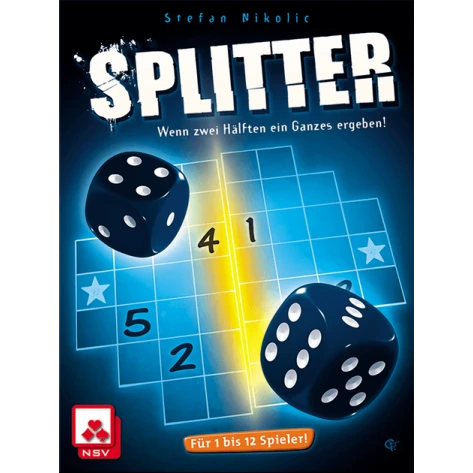
In Splitter, you must group numbers together to score points — two 2s, three 3s, and so on — but you're placing two numbers at a time, so things won't always work out.
Each player has their own score sheet with 44 empty spaces on it, with two different patterns of spaces included in the box; each pattern has a dashed line through the middle that splits it into two mirrored halves.
On a turn, someone rolls two six-sided dice. Each player then writes the results, e.g. 1 and 4, in empty spaces in the pattern, with each number being in the mirrored space of the other. If, say, you place the 1 in the leftmost space of the top row, then you must place the 4 in the rightmost space of the top row.
After 22 dice rolls, everyone's pattern will be filled. Each 1 on its own — that is, with no other 1s orthogonally adjacent — scores 1 point; each set of two 2s that have no other orthogonally adjacent 2s score 2 points; and so on up to a set of six 6s with no other orthogonally adjacent 6s being worth 6 points. A starred space is present on each half of the pattern, and a scored group that contains this starred space has its points doubled. (One pattern has a set of three spaces with hearts, and if you fill all three hearts with the same number, you score 5 points.)
Whoever has the highest score wins.

| Ages: | 8+ |
| NoOfPlayers: | 1-12 Players |
| PlayTime: | 15-15 Minutes |
| Playing Time : | Under 30 Minutes |
| BGG Link: | BGG Link |
| Game Mechanisms: | Dice Rolling | Pattern Building |
| Game Family: | Mechanism: Roll-and-Write | Players: Games with Solitaire Rules |
| Game Designer(s): | Stefan Nikolic |
| Game Artist(s): | Oliver Freudenreich |
| BGG Rank Overall: | 11558 |
| BGG Weight: | 1 |
| BGG Weight Filter: | <2 |
In Splitter, you must group numbers together to score points — two 2s, three 3s, and so on — but you're placing two numbers at a time, so things won't always work out.
Each player has their own score sheet with 44 empty spaces on it, with two different patterns of spaces included in the box; each pattern has a dashed line through the middle that splits it into two mirrored halves.
On a turn, someone rolls two six-sided dice. Each player then writes the results, e.g. 1 and 4, in empty spaces in the pattern, with each number being in the mirrored space of the other. If, say, you place the 1 in the leftmost space of the top row, then you must place the 4 in the rightmost space of the top row.
After 22 dice rolls, everyone's pattern will be filled. Each 1 on its own — that is, with no other 1s orthogonally adjacent — scores 1 point; each set of two 2s that have no other orthogonally adjacent 2s score 2 points; and so on up to a set of six 6s with no other orthogonally adjacent 6s being worth 6 points. A starred space is present on each half of the pattern, and a scored group that contains this starred space has its points doubled. (One pattern has a set of three spaces with hearts, and if you fill all three hearts with the same number, you score 5 points.)
Whoever has the highest score wins.
