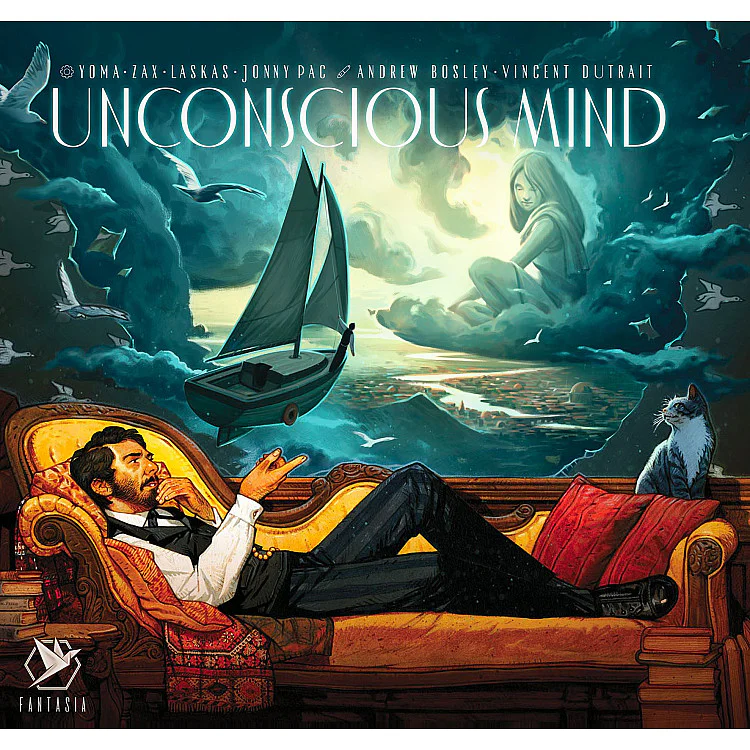
Unconscious Mind Deluxe Edition
In the early 1900s, the Austrian neurologist Sigmund Freud established a revolutionary theory called psychoanalysis, related to the study of the unconscious mind. As his work took hold, supporters met at Freud's apartment every Wednesday to discuss psychology and dream symbolism. This group—the Wednesday Psychological Society—marked the beginning of the worldwide psychoanalytic movement. As a member of this society, you aim to formulate new therapeutic techniques, establish a practice, grow your clientele, and become Freud’s most distinguished contemporary. To best accomplish this, you’ll need to share insights, discuss ideas with peers, and publish theories. And to stay invigorated, you’ll likely need some coffee—lots of coffee.
Unconscious Mind is a euro-style game featuring worker placement, engine building, multiple rondels, and cascading effects. On your turn, you may place one or two Ideas (workers) on a central Meeting Table to access a variety of actions, such as adding tiles to your player board, drafting and playing cards, and moving around the city of Vienna. Where you place your Ideas also determines how far to advance your rondel’s inkpot, activating a row or column of tile effects on your player board.
To treat your clients and interpret their dreams, you must work with a supply of Insight resources, which you’ll manage on a multi-level dial. As you work through surface-level Manifest dreams into deep-seated Latent dreams, these Insights will help your clients reach catharsis. This is represented by lifting transparent layers from the client cards—unlocking their ongoing special abilities and end-game scoring opportunities.
Once the group has solidified its reputation, the end of the game is signaled, and the member with the most points wins.
—description from the publisher

| Ages: | 12+ |
| NoOfPlayers: | 1-4 Players |
| PlayTime: | 60-120 Minutes |
| Playing Time : | Upto 2 Hours |
| BGG Link: | BGG Link |
| Game Type: | Strategy Games |
| Game Categories: | Medical | Post-Napoleonic |
| Game Mechanisms: | Contracts | End Game Bonuses | Layering | Melding and Splaying | Open Drafting | Programmed Movement |
| Game Family: | Cities: Vienna (Austria) | Components: Transparent Elements | Crowdfunding: Kickstarter | Digital Implementations: TableTop Simulator Mod (TTS) | Game: Unconscious Mind | Mechanism: Tableau Building |
| Game Designer(s): | Laskas | Jonny Pac | Yoma | Antonio Zax |
| Game Artist(s): | Andrew Bosley | Vincent Dutrait | Yoma |
| BGG Rank Overall: | 358 |
| BGG Weight: | 4.01 |
| BGG Weight Filter: | 4 to 5 |
In the early 1900s, the Austrian neurologist Sigmund Freud established a revolutionary theory called psychoanalysis, related to the study of the unconscious mind. As his work took hold, supporters met at Freud's apartment every Wednesday to discuss psychology and dream symbolism. This group—the Wednesday Psychological Society—marked the beginning of the worldwide psychoanalytic movement. As a member of this society, you aim to formulate new therapeutic techniques, establish a practice, grow your clientele, and become Freud’s most distinguished contemporary. To best accomplish this, you’ll need to share insights, discuss ideas with peers, and publish theories. And to stay invigorated, you’ll likely need some coffee—lots of coffee.
Unconscious Mind is a euro-style game featuring worker placement, engine building, multiple rondels, and cascading effects. On your turn, you may place one or two Ideas (workers) on a central Meeting Table to access a variety of actions, such as adding tiles to your player board, drafting and playing cards, and moving around the city of Vienna. Where you place your Ideas also determines how far to advance your rondel’s inkpot, activating a row or column of tile effects on your player board.
To treat your clients and interpret their dreams, you must work with a supply of Insight resources, which you’ll manage on a multi-level dial. As you work through surface-level Manifest dreams into deep-seated Latent dreams, these Insights will help your clients reach catharsis. This is represented by lifting transparent layers from the client cards—unlocking their ongoing special abilities and end-game scoring opportunities.
Once the group has solidified its reputation, the end of the game is signaled, and the member with the most points wins.
—description from the publisher