Menu
Menu
Your Cart
We use cookies and other similar technologies to improve your browsing experience and the functionality of our site. Privacy Policy.

SHIPPING DELAY: Dear all, We are shipping preorders. Your order shipping will be delayed.

Han

Han On demand, Imported Games, All Products image
Out Of Stock
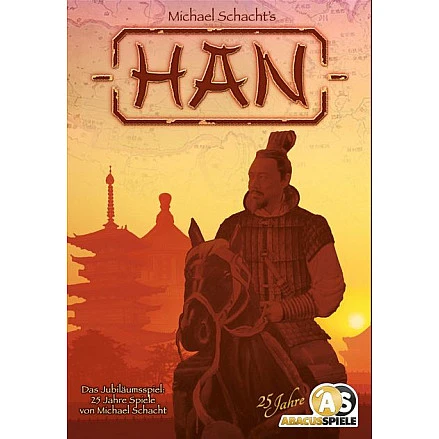
Han

For the most part, Han uses the same gameplay as China, also from designer Michael Schacht, but the maps on the double-sided game board introduce new rules and variants.

In general, players use cards to place pieces (houses or emissaries) into the nine regions on the board. To place in a region, a player must play a card of that region's color or two cards of the same color as a joker; a player can place at most two pieces in a region on a turn, but only one piece if the region was unoccupied at the start of the turn. One side of the game board — titled "Grenzstreitigkeiten", or "Border Disputes", and made for 3-5 players — includes house sites that straddle two regions; to claim one of these locations, a player must discard two appropriately-colored cards. The number of emissaries in a region is limited to the number of houses of the same color in that same region.

When all house spaces in a region are filled (or at the end of the game), players score for that region. Whoever has the most houses in that region scores one point for each house in the region, whoever has the secondmost houses scores one point for each house of the player who has the most, and so on.

At game end, players also score for having majorities of emissaries in two adjacent regions, scoring as many points as the number of emissaries in both regions. Players also score for having four or more houses in an uninterrupted sequence along one of the roads on the board. On the "Grenzstreitigkeiten" game board, players also score majority points for the houses in the port cities located in multiple regions, these port cities effectively forming their own region. Whoever scores the most points wins.

"Grenzstreitigkeiten" has one variant. Each player starts with one fortification in addition to his other pieces. Once per game, a player can play two matching cards, then place his fortification on a house site, then top it with a house. Whenever this house scores — whether for the region majority, for being a port city, or for being part of a sequence — the house's owner scores double the points he normally would.

The other side of the game board — "Wege der Diplomatie", or "Ways of Diplomacy", which is made for 2-4 players — also has a variant, with each player receiving a marketplace. Once per game, a player can play two matching cards, then place the marketplace on a house site, then top it with an emissary (not a house). This allows a player to compete for emissary points in a region that is otherwise full.

₹ 9,999.00
Ex Tax: ₹ 9,999.00
₹ 9,999.00 PRICE ALERT
The price shown is not actual but an automated place holder value. The same will be updated once we have correct price from publisher/supplier.
WE CAN GET THIS GAME ON REQUEST
It is our aim to make many board games available to you at affordable prices.
Please use the "REQUEST THIS GAME" option and We will send you an email when the item is available for Ordering.
It will take anywhere between 1 to 3 months or more in case of Kickstarter games
Ages: 10+
NoOfPlayers: 2-5 Players
PlayTime: 45-45 Minutes
Playing Time : Upto 1 Hour
BGG Link: BGG Link
Game Type: Strategy Games
Game Categories: Ancient | Territory Building
Game Mechanisms: Area Majority / Influence | Hand Management | Network and Route Building | Open Drafting
Game Family: Components: Map (Continental / National scale) | Country: China | Series: Web of Power / China
Game Designer(s): Michael Schacht
Game Artist(s): Michael Schacht
BGG Rank Overall: 4671
BGG Weight: 2.18
BGG Weight Filter: 2 to 3

For the most part, Han uses the same gameplay as China, also from designer Michael Schacht, but the maps on the double-sided game board introduce new rules and variants.

In general, players use cards to place pieces (houses or emissaries) into the nine regions on the board. To place in a region, a player must play a card of that region's color or two cards of the same color as a joker; a player can place at most two pieces in a region on a turn, but only one piece if the region was unoccupied at the start of the turn. One side of the game board — titled "Grenzstreitigkeiten", or "Border Disputes", and made for 3-5 players — includes house sites that straddle two regions; to claim one of these locations, a player must discard two appropriately-colored cards. The number of emissaries in a region is limited to the number of houses of the same color in that same region.

When all house spaces in a region are filled (or at the end of the game), players score for that region. Whoever has the most houses in that region scores one point for each house in the region, whoever has the secondmost houses scores one point for each house of the player who has the most, and so on.

At game end, players also score for having majorities of emissaries in two adjacent regions, scoring as many points as the number of emissaries in both regions. Players also score for having four or more houses in an uninterrupted sequence along one of the roads on the board. On the "Grenzstreitigkeiten" game board, players also score majority points for the houses in the port cities located in multiple regions, these port cities effectively forming their own region. Whoever scores the most points wins.

"Grenzstreitigkeiten" has one variant. Each player starts with one fortification in addition to his other pieces. Once per game, a player can play two matching cards, then place his fortification on a house site, then top it with a house. Whenever this house scores — whether for the region majority, for being a port city, or for being part of a sequence — the house's owner scores double the points he normally would.

The other side of the game board — "Wege der Diplomatie", or "Ways of Diplomacy", which is made for 2-4 players — also has a variant, with each player receiving a marketplace. Once per game, a player can play two matching cards, then place the marketplace on a house site, then top it with an emissary (not a house). This allows a player to compete for emissary points in a region that is otherwise full.

Write a review

Note: HTML is not translated!
Rating
Bad Good
Captcha

This product is currently Out-of-Stock and we can source this game on request from one of our supplier.

Enter your email address below and we will notify you as soon as the product is available.

Email
Comments