Dreamworld: An Unconscious Mind Card Game
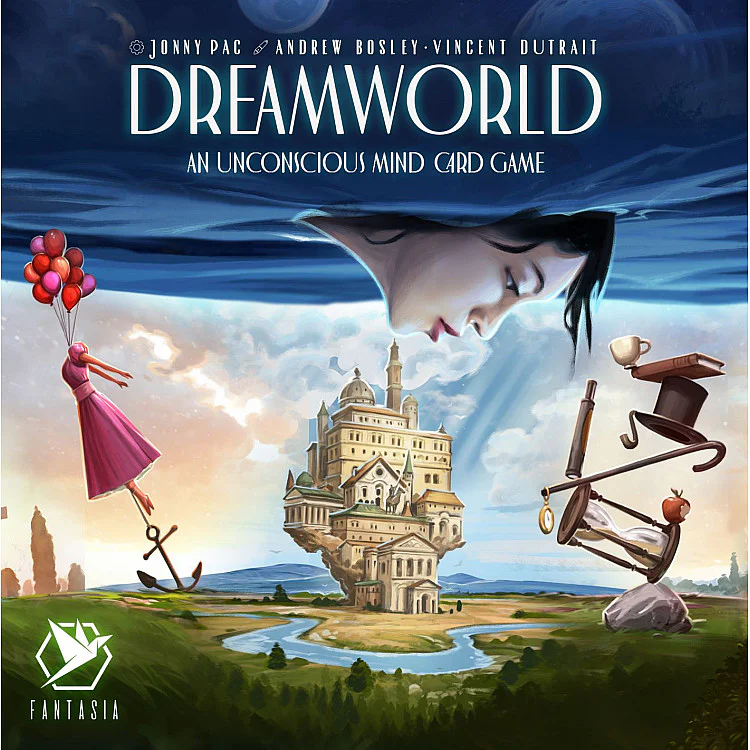
Dreamworld is a lightweight card game for 2–4 players that plays in 20–30 minutes. It is designed by Jonny Pac, co-designer of Unconscious Mind and the lead developer for Fantasia Games.
As a follower of Freud’s theories of the unconscious mind, your goal is to help suffering people recover from their psychological traumas. You can foster each client’s healing potential by interpreting the symbolism of their dreams.
At the start of a round, each player chooses a dream card and simultaneously reveals it. Next, you’ll arrange the cards numerically beside the current client. The difference between your card’s number and the next limits how many treatment tokens you may score: the bigger the gap, the better. If you’re the first to complete all your tokens, it proves your treatments were the most effective—making you Freud’s most formidable contemporary.
—description from the publisher

| Ages: | 12+ |
| NoOfPlayers: | 1-4 Players |
| PlayTime: | 20-30 Minutes |
| Playing Time : | Under 30 Minutes |
| BGG Link: | BGG Link |
| Game Categories: | Card Game | Number |
| Game Mechanisms: | Hand Management | Simultaneous Action Selection | Victory Points as a Resource |
| Game Family: | Card Games: Climbing | Digital Implementations: TableTop Simulator Mod (TTS) | Theme: Dreams / Nightmares | Theme: Psychology |
| Game Designer(s): | Jonny Pac |
| Game Artist(s): | Andrew Bosley | Vincent Dutrait | Yoma |
| BGG Rank Overall: | 10707 |
| BGG Weight: | 1.83 |
| BGG Weight Filter: | <2 |
Dreamworld is a lightweight card game for 2–4 players that plays in 20–30 minutes. It is designed by Jonny Pac, co-designer of Unconscious Mind and the lead developer for Fantasia Games.
As a follower of Freud’s theories of the unconscious mind, your goal is to help suffering people recover from their psychological traumas. You can foster each client’s healing potential by interpreting the symbolism of their dreams.
At the start of a round, each player chooses a dream card and simultaneously reveals it. Next, you’ll arrange the cards numerically beside the current client. The difference between your card’s number and the next limits how many treatment tokens you may score: the bigger the gap, the better. If you’re the first to complete all your tokens, it proves your treatments were the most effective—making you Freud’s most formidable contemporary.
—description from the publisher
